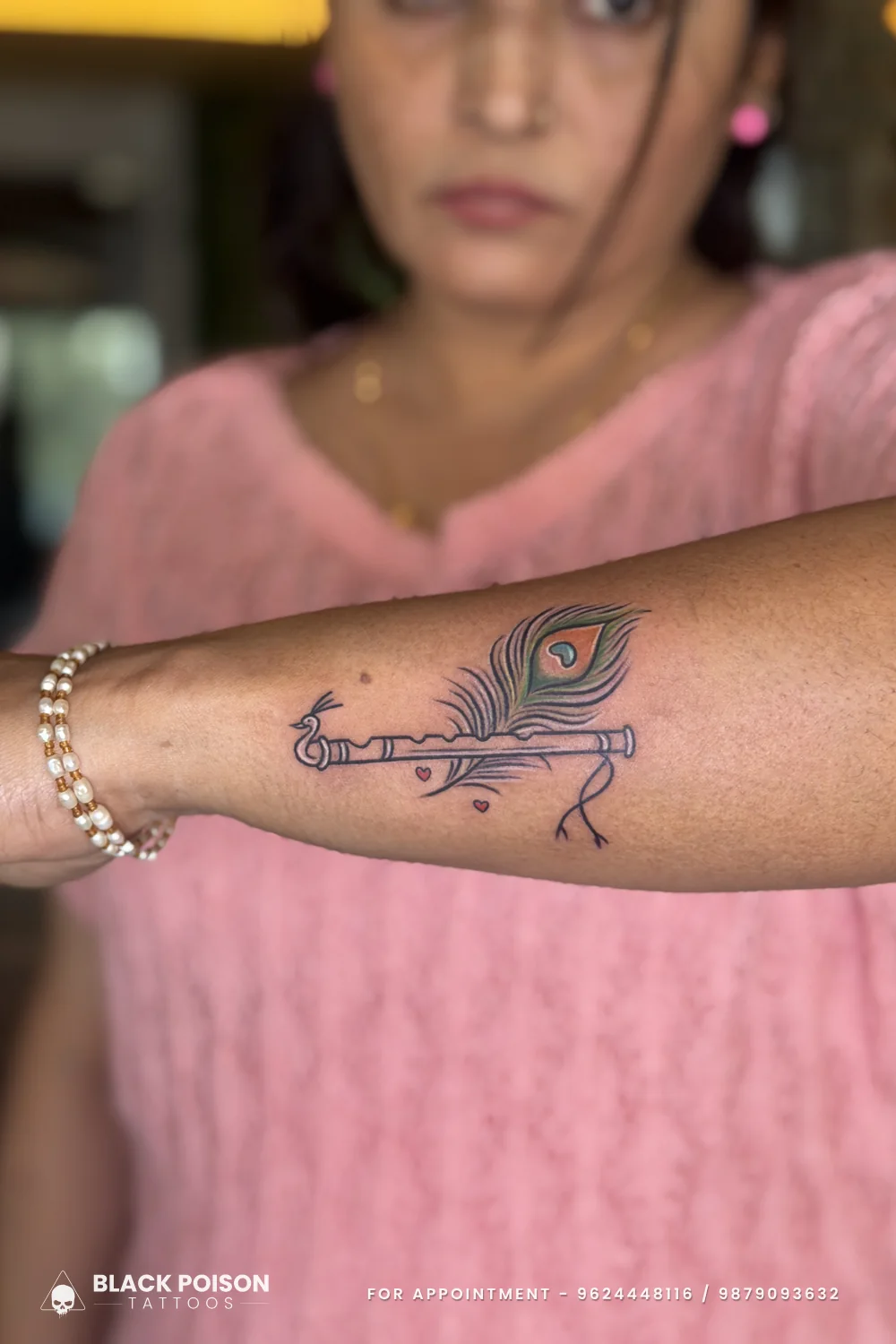
This piece combines Krishna's two best known symbols in one small tattoo on the inner forearm, just above the wrist. A slim bansuri, the bamboo flute, lies across the arm in fine black line, and a peacock feather rises from it in soft green and blue with an orange centre in the eye. A few tiny dots and a small heart-shaped drop sit beneath the flute. It was tattooed in a single sitting at Black Poison Tattoo Studio in Ahmedabad.
How the flute and feather sit on the forearm
The flute runs horizontally across the inner forearm, with its finger holes marked as a row of tiny dots and a small curl at the mouthpiece end. The feather springs from the far end of the flute and curls upward, so the composition forms a gentle L shape that fits the width of the arm without wrapping around it. Placed a little above the bracelet line, the tattoo is fully visible when the palm is turned up and mostly hidden with the arm at rest. The scattered dots below the flute keep the lower half from feeling empty.
Fine line black with soft colour
The flute and the feather's spine are fine line work in black, drawn with a single thin needle. The feather itself is where the colour comes in: layered green along the barbs, a ring of blue and a warm orange centre for the eye, blended softly rather than outlined. Colour packed lightly like this looks natural but is more delicate than solid colour, and pale greens and blues on the inner forearm can fade a little faster than black. Keeping the tattoo out of direct sun during healing and using sunscreen afterwards makes a real difference, and a colour refresh after a few years is normal for pieces like this.
What the bansuri and peacock feather mean
The bansuri is Krishna's instrument, and its music stands for divine love, joy and the call that draws the soul towards God. The peacock feather, worn in his crown, represents beauty, grace and protection. Together they are the most compact way to carry Krishna without depicting his full form, which is why the pairing is one of the most requested devotional designs in Ahmedabad, particularly among women. Many wearers choose it to mark a personal bhakti practice or as a reminder to meet life with the lightness that Krishna's stories describe.
Like this piece? Browse more fine line tattoos and Hindu mythology tattoos, or book a free design consultation online at Black Poison Tattoo Studio, Bodakdev, Ahmedabad. Send us your reference and placement and we will reply with a custom design and a quote.
Frequently Asked Questions
How much does an inner forearm tattoo near the wrist hurt?
The inner forearm is a little more sensitive than the outer side, and the closer to the wrist the sharper it feels. This piece sits above the most tender zone and is small, so most people find it very manageable. Fine line work uses light pressure, and the colour shading in the feather is soft rather than heavily packed.
Will the green and blue in the feather fade?
Colour tattoos hold well when healed properly, but pale greens and blues do soften more than black over the years, especially with sun exposure. Use sunscreen on the area once it has healed and avoid long soaks during the first two weeks. If the feather looks lighter after a few years, a short session brings the colour back.
What does a Krishna flute and peacock feather tattoo mean?
The flute is Krishna's bansuri and represents divine music, love and the joy of devotion. The peacock feather from his crown stands for beauty, protection and grace. Worn together they are a quiet way of carrying Krishna every day. It is a popular choice for people who follow a bhakti path or simply feel connected to Krishna's stories.
Can I get this design in all black instead of colour?
Yes. The feather works well in black and grey with the eye shaded in soft grey tones, or as a pure fine line outline. All-black versions age slightly more evenly than colour. We can also add a small Radhe Krishna script, an Om or a name beside the flute. Tell us the version you prefer and we will draw it to fit.