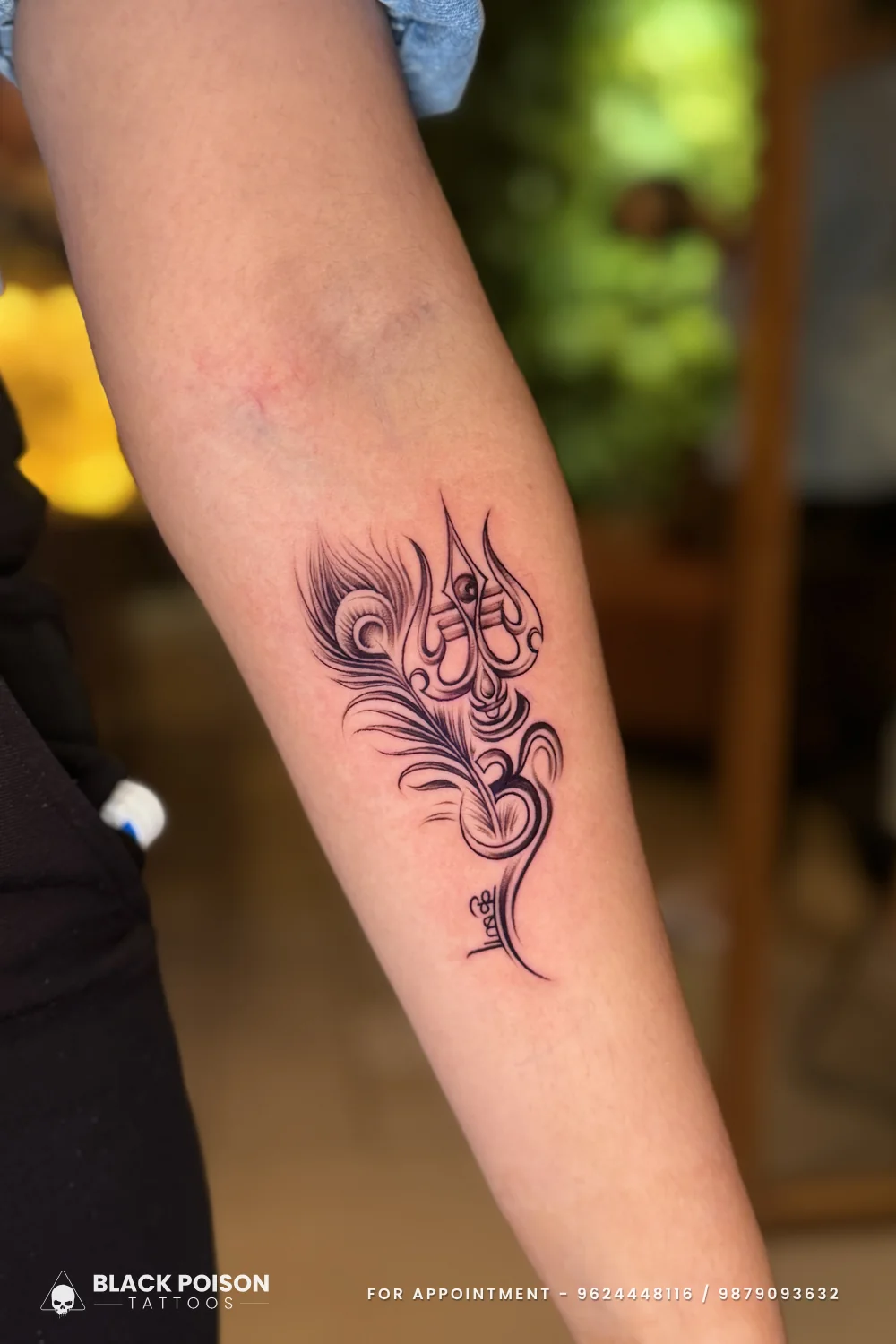
This fine line spiritual piece combines three symbols in one vertical design on the forearm, just below the elbow. A slender trishul rises through the centre with a small dotted swirl between its prongs, the shaft ends in a curling Om symbol at the base, and a peacock feather sweeps up the left side with its eye resting against the trident. Everything is drawn in thin black line with light grey shading in the feather. It was tattooed at Black Poison Tattoo Studio in Ahmedabad in a single session.
Trishul, Om and feather in one upright design
The composition reads from the bottom up. The Om sits at the base as a compact curl, the trishul shaft grows straight out of it, and the three prongs open at the top with a fine dotted swirl filling the gap between them. The peacock feather balances the left side, its barbs fanning out into soft wisps that echo the curves of the prongs. On the forearm below the elbow the design stands upright when the arm hangs naturally, so it reads correctly to anyone looking at it and never crosses a joint. It is roughly palm height, visible in short sleeves and easy to cover.
Fine line with soft feather shading
The trishul and the Om are clean single-needle line, kept slightly heavier than the finest hairline so the prongs and curls stay crisp. The feather is where the shading lives: a soft grey wash inside the eye and along the barbs, blended lightly so it looks airy rather than solid. Fine line pieces with light grey do soften over the years, and the feather's wisps will be the first to gentle out. The forearm gets sun, so sunscreen after healing helps, and a touch-up much later can restore the detail. The heavier line of the trishul itself holds well.
What the three symbols mean together
The trishul is Shiva's trident, representing his power over creation, preservation and destruction, and the overcoming of physical, mental and spiritual suffering. Om is the primal sound, the vibration behind everything, and placing it at the base grounds the whole design in that idea. The peacock feather belongs to Krishna, and it adds beauty, grace and protection. Bringing Shiva and Krishna symbols together in one piece is a personal choice many devotees make, and this fine line, feminine treatment is a popular request from women in Ahmedabad who want a spiritual tattoo that feels light rather than heavy.
Like this piece? Browse more fine line tattoos and Lord Shiva tattoos, or book a free design consultation online at Black Poison Tattoo Studio, Bodakdev, Ahmedabad. Send us your reference and placement and we will reply with a custom design and a quote.
Frequently Asked Questions
Does a tattoo just below the elbow hurt?
The forearm below the elbow is a comfortable spot for most people, with muscle under the skin and few nerve endings. The section closest to the elbow crease can feel a little sharper. Fine line work uses light pressure, and a piece this size is usually finished within an hour, so the discomfort is short.
How do I look after a fine line spiritual tattoo?
Wash it gently twice a day, pat dry and apply a thin layer of aftercare balm. Avoid tight sleeves rubbing on the lines and do not soak it for the first two weeks. Keep the forearm out of direct sun while healing, and use sunscreen afterwards, because sun is what fades fine grey shading like the feather fastest.
What does a trishul with Om and peacock feather mean?
The trishul is Shiva's trident and stands for power over the three worlds and the three kinds of suffering. Om is the sound of the universe and the root of all mantras. The peacock feather is Krishna's symbol of beauty and protection. Together they express devotion to Shiva and Krishna in one design, with the Om anchoring it in spiritual meaning.
Can I add a damru, Rudraksha or a name to this design?
Yes. A damru is often tied to the shaft, a Rudraksha bead or a crescent moon can sit near the prongs, and a short mantra or name can run beside the feather. The feather itself can also be done in colour. Send us the elements you want and we will draw a version that keeps the upright balance of the piece.