
The short answer: To choose a tattoo academy in India, ask for the syllabus, how hygiene is taught and assessed, who teaches, when real skin starts, what the fee covers and exactly what the certificate says, all in writing. Visit if you can. Treat promises of jobs or income, and recognition claims you cannot check, with caution.
We run a tattoo academy, so read this with that in mind. Here is the checklist we would use to judge us.
This guide is written by the team at Black Poison Tattoo Academy, part of Black Poison Tattoo Studio in Ahmedabad. The studio has been tattooing for 19+ years and has completed 2,00,000+ tattoos. Its 4.8 stars from 2,500+ Google reviews belong to the studio, not the Academy. No school is named or ranked here except ours, in one marked block. Outside facts are sourced at the end, and where we could not verify something, we say so.
What are your options, and where does an academy fit?
There are three real routes: a studio-based academy, a studio apprenticeship, and online learning. Tattooing yourself or friends is not a route. Our guide to becoming a tattoo artist in India compares them in full.
An India-focused career guide calls a formal apprenticeship the most widely respected entry route, and says most professionals recommend an apprenticeship and a course together. US sources say apprenticeships often run one to three years, are often unpaid or low paid at first, and that some mentors charge tuition. One US supplier adds that tuition is not a red flag by itself if the studio is reputable and the mentor has a real track record. We found no India-specific figures for length or pay.
So an academy is not automatically better or worse than an apprenticeship. It is a different deal: a set syllabus and a batch of learners, against one mentor and the daily life of a studio. The questions below apply to both, because an apprenticeship is a school with one teacher.
What should you ask any tattoo academy before you pay?
Tattoo academy mein paise dene se pehle kya poochhein?
Print this list, take it to every school you compare, and write the answers beside each number. Ask for them in writing.
The teaching
- Can I see the syllabus, month by month, on paper? One US training site, which sells its own course, says most schools do not focus on drawing or portfolio building. Check that yours does.
- How is hygiene taught, and how is it assessed? It should be taught and tested, not a talk on day one.
- When do students first work on real skin, and who decides they are ready? Practice skin first, then supervised real skin, with a named role making the call.
- Who teaches, and for how long have they tattooed professionally? Ask about the person who will teach you.
- How big is a batch, and how much individual feedback does each student get?
- In which language is the teaching done, and are the notes in that language?
- What is the weekly schedule, and what happens if I miss days?
The money and the paper
- What does the fee cover, and what must I buy separately? Ask about machines, needles, inks, kits and stationery.
- Can I get the full fee, the instalment plan and every extra cost in writing before I pay?
- Are exam, assessment or certificate fees extra?
- What exactly does the certificate say, and who issues it? Ask to see a sample.
- What are the refund and transfer terms if I cannot continue? Get them in writing before paying.
- What do you not promise? A good school can say in writing that it promises no job, income or licence.
The proof
- Can I see student work, and can I verify it? Ask whether the students agreed to it being shown.
- Who is the studio behind the school, and how long have the school and the studio each operated?
- What do the studio’s Google reviews say? Read recent reviews, the lowest ratings and the owner’s replies. They describe the studio, not necessarily the school. Google’s policy bans reviews that are paid for, incentivised, or posted from several accounts at one person’s request, so detailed, varied reviews tell you more than a wall of identical praise.
- Is there a health policy for artists and trainees, such as hepatitis B vaccination? We found no Indian rule on this, so treat it as a question, not a legal test.
- Can I visit and watch a working day before I decide? The visit-day list below says what to look for.
What do “government approved”, “ISO certified” and other recognition claims actually prove?
None of them is a tattoo licence, and none of them measures teaching quality. This is what we could read about each.
“Government approved” or “recognised”. Karnataka health officials, reported by MedBound Times in August, said there is currently no specific legislation in the country governing tattooing. An India-focused career guide says finishing a course in India does not confer a government-recognised professional licence. In what we read, we found no national body that approves tattoo schools. That does not prove none exists. Ask which department, which order or number, and what exactly was approved: the school, a course or a certificate. Then check with that department, not the school.
“MSME registered” or “Udyam registered”. The Ministry of MSME’s Udyam portal describes registration as online, paperless, self-declared and free, with enterprises classified by investment and turnover. Nothing on the page we read mentions the quality of any service, teaching included.
“ISO certified”. ISO’s own page says ISO does not perform certification or issue certificates; external certification bodies do. Its management system standards cover the way an organization manages the interrelated parts of its business, and certification to them is not a requirement. Our reading: a certificate about how a business runs its processes does not say its students can tattoo. Ask which standard, which certification body and what the scope says. ISO points to the IAF CertSearch database for checking.
“NSQF aligned” or “NCVET”. A skills-sector explainer we read says every qualification must be approved by the National Skills Qualification Committee before it is listed on the National Qualifications Register, which names awarding bodies. A training provider’s explainer calls the NSQF a scale, not an organisation, and says the awarding body is the whole question. Ask which qualification, at which level, awarded by which body. We could not open the regulator’s pages or the register (they failed to load), so we cannot say whether any tattoo qualification is listed. Check it yourself.
“Internationally recognised”. We found no source we could open that defines what this means for a tattoo school certificate. Ask which organisation outside India recognises it, and how you can confirm that with them.
Any of these can be true and still tell you nothing about whether you will be taught well.
How do tattoo academy fees work, and how do you compare the real cost?
We found no source describing how fees are structured across Indian tattoo schools, so this is our own checklist, not a survey, and it contains no price figure. Compare total cost, not the headline fee. For each school ask in writing:
- What the fee covers (tuition, practice materials, notes, assessments, certificate) and what it does not (machines, needles, inks, a starter kit).
- Any admission, registration, exam or certificate fee on top.
- Whether you can pay in instalments, the amount and date of each, and what happens if you stop, including refund and transfer terms.
- Travel and stay, if you are moving from another city.
- Whether the same fee is quoted on the website, on social media and by the person you speak to. In our own review of providers’ pages we saw different figures for one course on one school’s own pages, and promotional discounts already out of date on third-party sites.
Some schools do not publish their fees, and that is not a red flag on its own. Ask for the full fee in writing before you pay, whoever the school is. A US training site suggests a contract and payments tied to agreed milestones. Do the same with us.
Can you choose an online tattoo course instead?
Drawing, design and theory can be learned online. The US training site that sells an online course warns that not all online information is correct, or even safe.
Our view as a school is that hygiene practice, machine handling and reading skin need someone watching your hands. A York Region (Canada) public health fact sheet lists checking the client’s skin for cuts, wounds and signs of infection, and refusing service if found, as an operator’s duty. That habit is best taught face to face.
If you are weighing an online course, ask where the supervised hands-on part happens, who watches it, and how hygiene is assessed. If nowhere, treat it as a design and theory course.
What should you look for on a visit day?
Visiting is your choice, but it is the best test there is. If you go, take this list.
- Needles: single-use, sterile and sealed until the moment of use, then straight into a sharps container kept at the station.
- Between clients: gloves changed, reusable equipment cleaned and reprocessed, surfaces disinfected.
- The client: is their skin checked first, and is aftercare given in speech and in writing?
- The practice area: is there practice skin, and how many students share one instructor?
- The paper: syllabus, assessment sheet, sample certificate and written fee terms in your hands before you leave.
- The person: can you meet whoever would teach you, and do they answer plainly without pressure?
What are the red flags?
These are our own judgement, not a legal test.
- A promise of a job, placement or income.
- Pressure to pay today, or a seat countdown.
- Recognition claims with no named body to check.
- No written syllabus, or no hygiene in it.
- Real skin in the first week.
- A certificate promised for payment alone.
- A fee that changes, or terms not in writing.
- No studio to visit and no one to ask.
How do academies compare on what matters?
Use this table beside your own notes. It names no school.
| What to compare | A strong answer looks like | A weak answer looks like |
|---|---|---|
| Syllabus | Written, month by month, with drawing and hygiene in it | Verbal only, or a list of machines and styles |
| Hygiene | Taught as a subject and assessed before the certificate | One demonstration, or not mentioned |
| First real skin | After practice skin, on a mentor’s decision | Week one, or no fixed rule |
| Teachers | Named by role, with years tattooing professionally | Vague titles or no answer |
| Fee | Full amount, inclusions and extras in writing | A headline figure that moves |
| Certificate | Issued by the school, wording shown, no licence implied | “Recognised” or “approved” with no body named |
| Proof | Verifiable student work, a studio you can visit | Stock images and no studio |
How does Black Poison Tattoo Academy answer these questions?
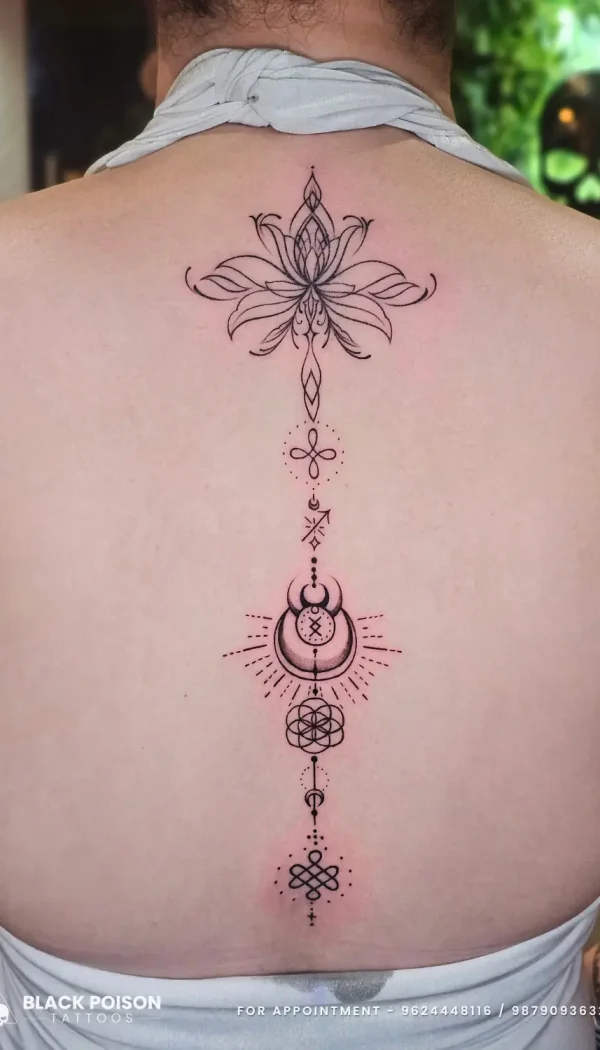
This block is our own answer, so weigh it as the publisher’s view. The studio’s tattoo portfolio shows the standard students learn from.
- Syllabus: the Professional Tattoo Artist Course runs 4 to 6 months, 5 days a week, month by month from Drawing and Art Fundamentals to Portfolio and Final Assessment.
- Hygiene: hygiene and safe studio practice is assessed before a certificate is issued.
- Real skin: practice on synthetic skin comes first. Supervised work on real skin happens only when the mentor confirms readiness, after skill and hygiene checks.
- Teachers: lead trainers with 18 years in the tattoo industry, and working artists of Black Poison Tattoo Studio.
- Batches: small batches so every student gets individual attention.
- Included: stationery, drawing and practice materials, and course notes. Machines and personal equipment are bought separately.
- Certificate: a Certificate of Completion issued by Black Poison Tattoo Academy, after the required training and assessments. It is not a licence, and we make no recognition claim.
- Language and place: English, Hindi and Gujarati, at the Academy in Bodakdev, Ahmedabad. Students from other cities and countries are welcome. Minimum age 18, minimum education 10th pass.
- Fee: we do not publish it. Ask for the full fee on WhatsApp and get it in writing before you pay. Payment options are explained when you enquire.
- What we cannot show yet: student work and student reviews. We have none to show yet. We promise no job, income or placement.
See the tattoo courses in Ahmedabad overview or the Professional Tattoo Artist Course in Ahmedabad.
Chat on WhatsApp about the Professional course. Fees are shared there.
Frequently asked questions
How do I choose a tattoo academy in India?
Tattoo academy kaise choose karein?
Compare schools on the same written points: syllabus, hygiene teaching and assessment, when real skin starts, who teaches, what the fee covers, and exactly what the certificate says. Visit if you can, and get everything in writing before you pay.
Is a government approved or ISO certified tattoo academy better?
Not necessarily. We found no national tattoo licence, ISO does not certify organisations itself, and Udyam registration is a business classification. Ask which named body approved what, and check with it. None of these measures teaching quality.
What should a tattoo course fee include?
Ask what covers tuition, practice materials, notes, assessments and the certificate, and what you buy separately, such as machines. Ask about instalments, exam or certificate fees, refunds, and travel and stay. Get the full fee in writing before you pay, whoever the school is.
Is a tattoo apprenticeship better than an academy?
Neither wins for everyone. An India-focused guide calls apprenticeship the most widely respected route and says most professionals recommend both. Apprenticeships can be long and depend on one mentor. An academy gives a set syllabus and batch. We run an academy, so weigh our view.
Can I learn tattooing online?
Tattoo ghar par ya online kaise sikhe?
Drawing, design and theory can be learned online. Hygiene, machine handling and reading skin need someone watching your hands, and not all online information is correct or safe. Ask any online course where the supervised practice happens.
How do I spot a fake or poor tattoo academy?
Look for promises of jobs or income, pressure to pay today, no written syllabus, real skin in week one, recognition claims with no named body, fees you cannot get in writing, and no studio to visit.
Does a tattoo course certificate work as a licence?
No. An India-focused guide says a course does not confer a government-recognised professional licence, and Karnataka officials said there is no specific legislation on tattooing in the country. Rules may vary by city and state, so ask your local authority. This is not legal advice.
Sources
- ISO: Certification. https://committee.iso.org/certification.html
- ISO: What is a management system? https://committee.iso.org/management-system-standards.html
- ISO Help Centre: How to verify an accredited certification. https://help.iso.org/en/articles/424922-how-to-verify-an-accredited-certification
- Udyam Registration portal, Ministry of MSME, Government of India (home page). https://udyamregistration.gov.in/
- National Skills Network: Understanding the National Qualifications Register (NQR) in India. https://nationalskillsnetwork.in/national-qualifications-register-nqr-a-unified-platform-for-skill-based-qualifications/
- NNWA: What is NCVET certification, and is it valid? https://nnwa.in/blog/what-is-ncvet-certification/
- MedBound Times: Karnataka Plans Regulations to Put Checks on Tattooing over Health Concerns; Writes to Centre. https://www.medboundtimes.com/amp/story/india/karnataka-tattooing-regulations-health-risks
- CareerPlanB: Tattoo artist course in India. https://www.careerplanb.co/tattoo-artist-course-india/
- Google Maps contribution policy: Fake engagement and rating manipulation. https://support.google.com/contributionpolicy/answer/7400114
- Public Health, York Region (Ontario, Canada): Tattooing and Micropigmentation fact sheet. https://www.york.ca/resource/tattooing
- Tommy’s Supplies: How to Become a Tattoo Artist, The Apprenticeship Path Explained. https://www.tommyssupplies.com/blogs/news/how-to-become-a-tattoo-artist-the-apprenticeship-path-explained
- Tattooing 101: How to become a tattoo artist (guide). https://tattooing101.com/learn/category/guides/become-a-tattoo-artist/
Some of these are commercial sites or training providers, and several describe US or Canadian practice, not India. We used them only for the narrow points listed above. We could not open the Indian regulator’s own NSQF and register pages, so the NSQF paragraph rests on two secondary explainers. The Academy and studio facts are our own.
Last reviewed: at publication. We update this page as rules change.