Tattoo pain depends far more on where you get tattooed than on how tough you are. Areas with thin skin, dense nerve endings, or bone sitting close to the surface hurt the most. Areas with muscle and fat padding hurt the least. On a 1 to 10 scale, an outer forearm sits around 2 to 3, while ribs, hands and feet sit at 8 or above.
This guide maps every common placement to a pain level, explains why each one feels the way it does, and covers what actually reduces the discomfort. It is written from what our artists at Black Poison Tattoo Studio in Ahmedabad see in the chair every day.
What is a tattoo pain chart?
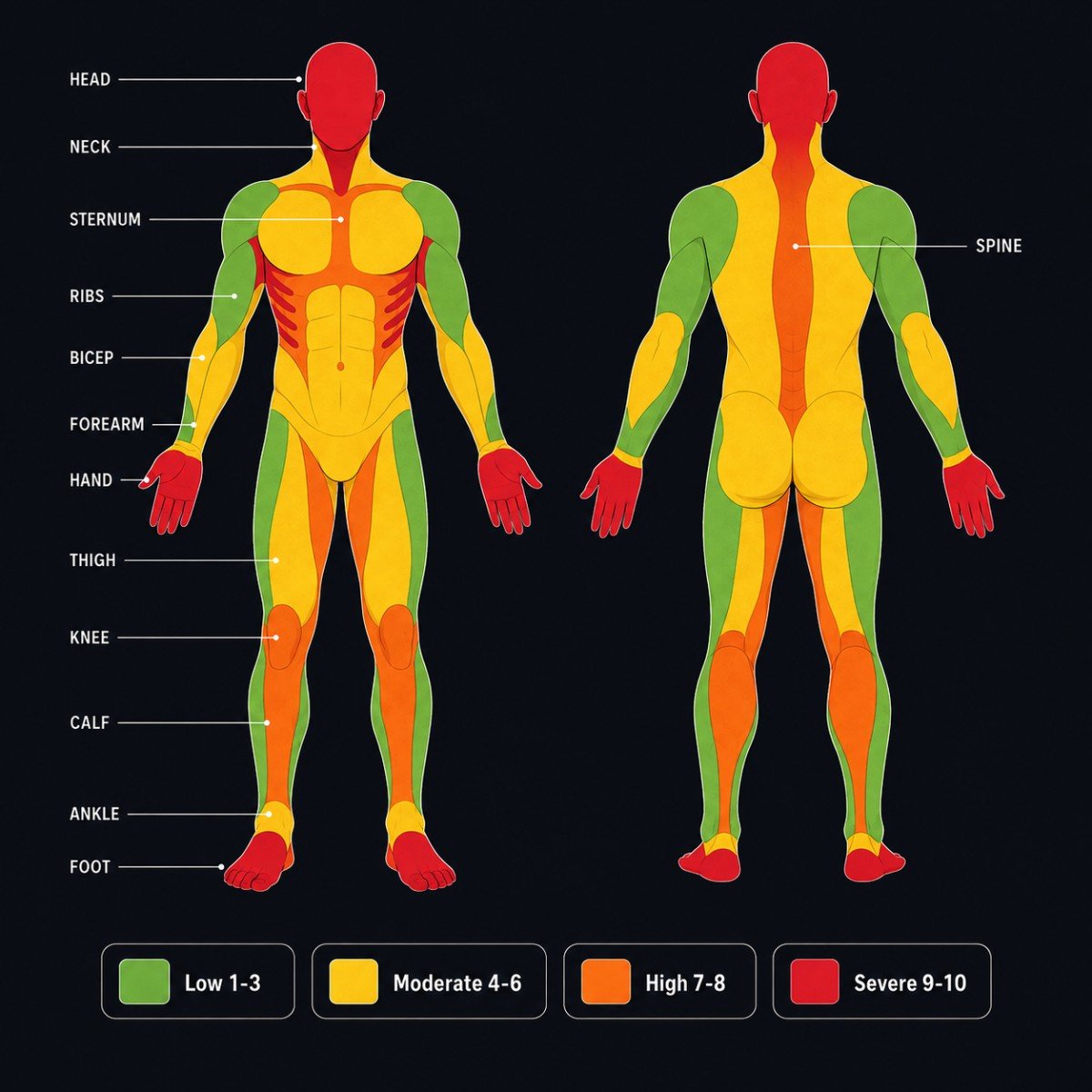
A tattoo pain chart is a body map that rates how much each placement typically hurts, usually on a scale of 1 to 10 and colour coded from low to severe. It is a general guide, not a promise: pain tolerance is personal, and the same spot can feel different on two people. What the chart does reliably is tell you which areas are predictably harder than others, so you can plan placement and session length around it.
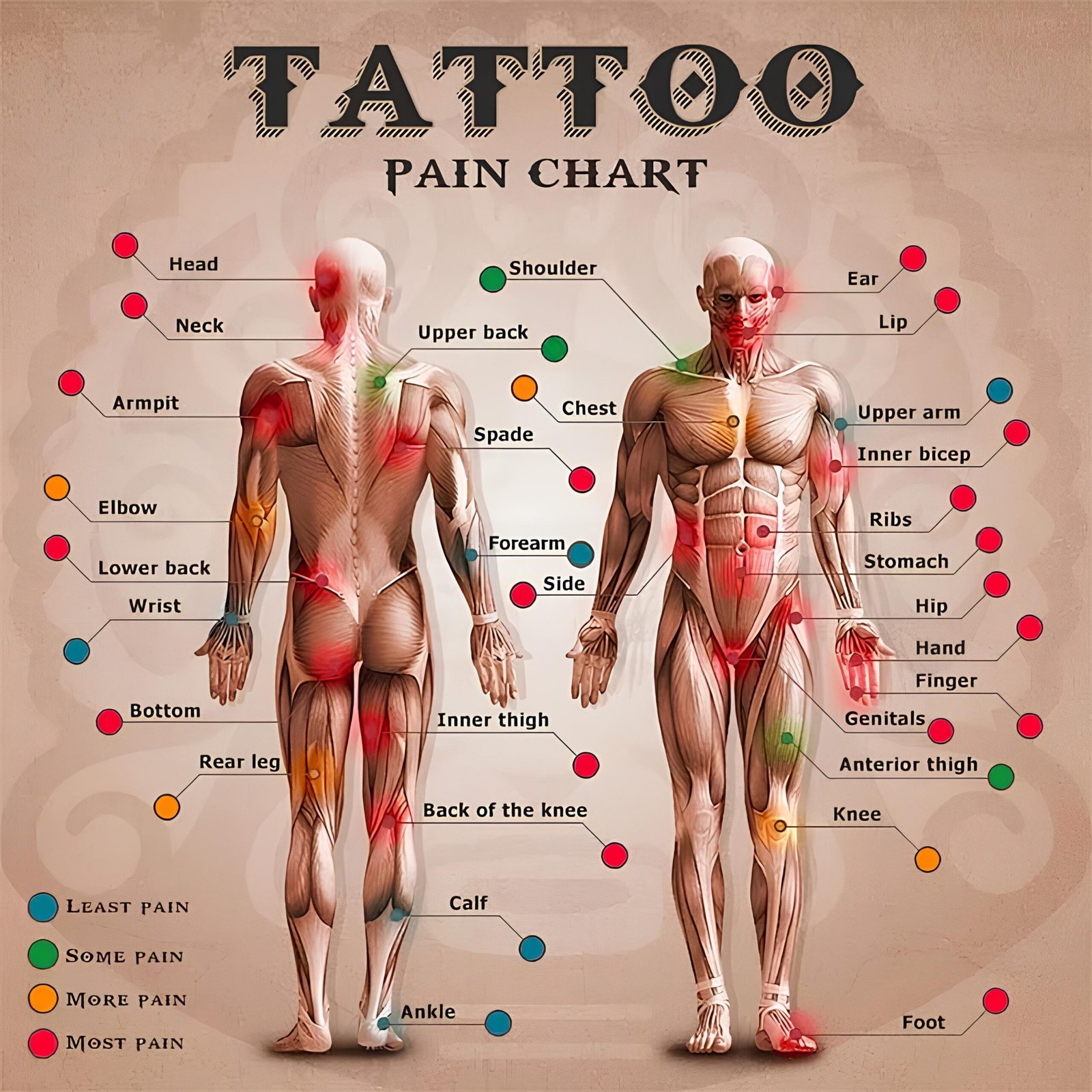
Tattoo pain chart by body part
The table below rates 34 common placements. Levels 1 to 3 are comfortable for most people, 4 to 6 are manageable, 7 to 8 need preparation, and 9 to 10 are demanding even for experienced clients.
| Body area | Pain level | Why it feels that way |
|---|---|---|
| Outer forearm | 2/10 | Thick skin, few nerve endings, muscle underneath |
| Outer bicep | 2/10 | Well padded with muscle, no bone near the surface |
| Calf | 3/10 | Thick muscle cushions the needle |
| Outer thigh | 3/10 | One of the best padded areas on the body |
| Shoulder | 3/10 | Stable skin over muscle, easy to sit through |
| Outer upper back | 3/10 | Muscle padding, away from the spine |
| Forearm inner side | 4/10 | Softer, more sensitive skin than the outer side |
| Front thigh | 4/10 | Fleshy, though it tightens over a long session |
| Lower back | 4/10 | Fleshy, but sharpens as you approach the spine |
| Buttocks | 4/10 | Thick fat layer absorbs most of the sensation |
| Upper arm inner side | 5/10 | Soft skin and more nerve endings |
| Stomach | 5/10 | Varies a lot with body type and skin tension |
| Hip | 5/10 | Comfortable over flesh, sharp over the hip bone |
| Upper chest | 5/10 | Manageable over the pec, sharp near the collarbone |
| Wrist | 6/10 | Thin skin, bone and tendons close to the surface |
| Side of neck | 6/10 | Thin skin over dense nerve endings |
| Inner thigh | 7/10 | Very soft, sensitive skin that is rarely exposed |
| Shin | 7/10 | Bone sits directly beneath thin skin |
| Elbow ditch | 7/10 | Thin skin over nerves that run close to the surface |
| Collarbone | 7/10 | Bone directly under the skin with no padding |
| Ankle | 7/10 | Bone close to the surface, very little fat |
| Behind the ear | 8/10 | Thin skin stretched over bone and cartilage |
| Ribs | 8/10 | Thin skin straight over bone, and it moves as you breathe |
| Sternum | 8/10 | Bone directly beneath, with almost no cushioning |
| Spine | 8/10 | Vertebrae sit immediately under the skin |
| Knee and kneecap | 8/10 | Bone under thin skin, plus joint movement |
| Back of the knee | 8/10 | Thin skin over a dense bundle of nerves |
| Elbow bone | 8/10 | Sharp, vibrating sensation straight through bone |
| Armpit | 9/10 | One of the densest concentrations of nerve endings |
| Hands and fingers | 9/10 | Thin skin, bone and constant nerve activity |
| Feet and toes | 9/10 | Bone close to the surface throughout |
| Head and scalp | 9/10 | Thin skin stretched directly over the skull |
| Face | 9/10 | Thin skin and a very high density of nerves |
| Genitals and nipples | 10/10 | The highest nerve density anywhere on the body |
Why do some spots hurt more than others?
Four things decide how much a placement hurts: how thin the skin is, how many nerve endings sit beneath it, how close the bone is to the surface, and how much fat or muscle is there to absorb the vibration. A tattoo needle only penetrates a couple of millimetres, so anywhere that has bone directly under thin skin transmits that vibration straight through.
- Skin thickness: thicker skin on the outer arm and calf dulls the sensation. Thin skin on the ribs, ankles and hands does not.
- Nerve density: hands, feet, armpits and the face carry far more nerve endings per square centimetre than the outer arm.
- Bone proximity: the spine, sternum, collarbone, knees and shins have bone sitting immediately under the skin, which turns the buzz into a sharp, rattling feeling.
- Fat and muscle padding: the outer thigh, bicep and calf have the most cushioning, which is exactly why they rank lowest.
- Session length: almost any placement becomes harder after the third or fourth hour. Endurance matters as much as the starting pain level.
Least painful places to get a tattoo
The outer forearm, outer bicep, calf, outer thigh and shoulder are the most comfortable placements, sitting around 2 to 3 out of 10. All five share the same advantages: thick skin, low nerve density and a solid layer of muscle. They are also large, flat and easy to work on, which makes them the best canvases for detailed pieces.
Best for: first tattoos, large and intricate designs, and long sessions. If you want a piece with fine detail, these areas also hold fine line tattoo work well over time.
Moderate pain areas
The inner forearm, front thigh, lower back, stomach, hip, upper chest and side of the neck sit in the 4 to 6 range. These are entirely manageable for most people, but the sensation is sharper and more noticeable than the low-pain zones, and it tends to build rather than fade as the session goes on.
The neck deserves a specific mention because it is a common request and a common surprise. The skin there is thin and sits over a dense run of nerves, so it reads higher than people expect from looking at a chart alone.
High pain areas
Ribs, sternum, spine, knees, ankles, shins, collarbones and the inner thigh land at 7 to 8 out of 10. In every case the reason is the same: thin skin with bone directly underneath, or skin that is rarely exposed and therefore far more sensitive. Ribs are the placement clients most often describe as harder than they expected, partly because the area moves constantly as you breathe.
Plan for these: keep the session shorter, eat properly beforehand, and expect to need breaks. Spine tattoos in particular are worth splitting across two sittings rather than pushing through in one.
Most painful places to get a tattoo
The armpit, hands and fingers, feet and toes, head, face, genitals and nipples are the most painful placements, rating 9 to 10 out of 10. These areas combine the thinnest skin on the body with the highest nerve density, and several of them sit directly over bone. They are demanding even for people with several tattoos already.
Hands and fingers carry a second consideration beyond pain: they fade faster than anywhere else because the skin regenerates quickly and gets constant use and sun exposure. Expect to plan for touch-ups. You can see how our artists approach this in the hand and forearm tattoo gallery.
Do tattoos hurt more for women than for men?
There is no meaningful difference in tattoo pain between men and women. Pain response varies far more between two individuals than it does between genders, and the physical factors that drive it, skin thickness, nerve density and bone proximity, are governed by the placement rather than by sex. The pain chart applies the same way to everyone.
What does genuinely change the experience is sleep, food, hydration, stress level and whether you have been tattooed before. Someone well rested and well fed will have an easier session than the same person running on no sleep and an empty stomach.
What does getting tattooed actually feel like?
Most people describe tattoo pain as a hot scratching sensation rather than a sharp stab. It is closer to a persistent cat scratch or mild sunburn than to an injection. The feeling changes depending on what the artist is doing at that moment.
- Lining: the sharpest, most precise sensation, because a tight needle grouping traces a single path.
- Shading: broader and duller, often described as a warm scraping. Many people find it easier than lining.
- Colour packing: the most repetitive, since the artist works over the same skin several times. This is where fatigue builds.
- Over bone: a rattling, vibrating feeling rather than a scratch.
Best placements for a first tattoo
For a first tattoo, pick the outer forearm, outer bicep, calf or shoulder. All four sit at the bottom of the pain scale, heal easily, are simple to keep clean, and can be covered or shown at will. Starting somewhere comfortable also tells you how your own body responds before you commit to a harder placement.
Keeping the first piece modest helps as much as the placement does. A shorter session means less accumulated soreness, and small tattoo designs let you test the experience without a four-hour sitting. Browse our minimalist and small tattoo gallery for scale reference.
How to make a tattoo hurt less
You cannot remove tattoo pain, but you can meaningfully reduce it. The biggest factors are within your control and happen before you sit down.
- Sleep properly the night before. Tiredness lowers pain threshold more than almost anything else.
- Eat a full meal beforehand. Stable blood sugar is what keeps you from feeling faint or shaky midway through.
- Hydrate well. Hydrated skin takes ink more readily, which shortens the session.
- Skip alcohol entirely. It thins the blood, increases bleeding and makes ink harder to set. Do not drink the night before either.
- Ask about numbing cream. For high-pain placements it genuinely helps, but it needs to be applied well before the session, so raise it when you book rather than on the day.
- Breathe steadily. Slow, regular breathing keeps you from tensing up. Holding your breath makes the sensation worse.
- Take the breaks you are offered. Pushing through without pausing is the most common reason a session ends early.
- Choose an experienced artist. A steady, efficient hand finishes the same piece in less time, and time in the chair is what most people actually struggle with.
How long does the pain last afterwards?
The tattoo itself usually feels like mild sunburn for two to three days, then settles into itching as it heals. Most people find the first 48 hours the most uncomfortable, with soreness fading noticeably by day three. High-pain placements such as ribs, feet and hands tend to stay tender a little longer because the skin moves and gets used constantly.
Sharp pain, spreading redness, swelling or heat after the first few days is not normal healing and should be looked at. Our tattoo aftercare guide covers the full healing timeline and what to do at each stage.
Does a bigger tattoo hurt more?
A bigger tattoo does not hurt more per second, but it hurts for longer, and cumulative soreness is what most people underestimate. A small piece on the ribs can be harder than a large piece on the outer thigh. When you are planning, weigh the placement and the expected session length together rather than judging by size alone. Size is also the main driver of what a tattoo costs.
Frequently asked questions
How painful is a tattoo on a scale of 1 to 10?
Most tattoos fall between 3 and 6 out of 10 on well padded areas such as the outer forearm, bicep, calf and thigh. Bony or nerve-dense placements including the ribs, spine, hands, feet and head sit at 8 to 10. The sensation is generally a hot scratching rather than a sharp stab.
What is the worst pain for a tattoo?
The most painful placements are the genitals and nipples, followed by the armpit, hands and fingers, feet and toes, head, face and ribs. These areas have the thinnest skin and the highest concentration of nerve endings, and several sit directly over bone with no fat or muscle to absorb the vibration.
What is the 1/3 rule for tattoos?
The one third rule is a design guideline rather than a pain rule. It suggests a tattoo should occupy approximately one third of the body area it sits on, leaving negative space around it so the piece reads clearly from a distance. It is a composition principle used to stop designs looking cramped, and it has no bearing on how much the tattoo will hurt.
Where does a tattoo hurt the least?
The outer forearm, outer bicep, calf, outer thigh and shoulder hurt the least, typically 2 to 3 out of 10. All five have thick skin, few nerve endings and a solid layer of muscle beneath, which cushions the needle. They are the placements most often recommended for a first tattoo.
Does numbing cream actually work for tattoos?
Yes, topical numbing creams reduce the sensation noticeably, particularly on high-pain placements. They need to be applied well before the appointment to take effect, and the effect wears off during longer sessions. Always discuss it with your artist when booking rather than applying something yourself on the day, since some products affect how the skin takes ink.
Do tattoos hurt more on skinny people?
Placements with less natural padding can feel sharper, because fat and muscle absorb some of the needle vibration. That said, body type matters far less than the specific placement. Ribs are demanding for everyone, and an outer thigh is comfortable for almost everyone, regardless of build.
Does a tattoo hurt more than a piercing?
A piercing is far more intense but lasts a second or two, while a tattoo is a lower level of pain sustained over a much longer period. Most people who have had both describe the piercing as sharper and the tattoo as more tiring. You can read more about what to expect from our piercing services in Ahmedabad.
Can I take a painkiller before getting tattooed?
Avoid aspirin and ibuprofen before a session, because both thin the blood and increase bleeding, which makes the tattoo harder to complete cleanly. Paracetamol is generally considered the safer option. Check with your artist first, and never use alcohol as a way to manage the pain.
Planning your tattoo around the pain chart
Placement should follow the design you want and how visible you need it to be, with the pain level as a planning input rather than the deciding factor. If a high-pain area is where the piece belongs, the answer is usually a shorter session and a well prepared body, not a compromise on placement.
If you are still deciding, our artists will walk you through placement, session length and what to expect before anything starts. You can book a consultation at Black Poison Tattoo Studio in Ahmedabad, or browse the full tattoo design gallery to see how different placements sit on real skin.
Still deciding on placement? Our artists advise on pain, placement and longevity at the best tattoo studio in Ahmedabad, Black Poison in Bodakdev. Consultations are free.